From the topic title, one might assume that I consider myself an internet celebrity. In actuality, I do not. Rather, I wish to talk about what I've noticed about people who become famous through the internet. I've noticed that the actual effects of being an internet celebrity are not that much different than becoming a celebrity in real life. Millions people know your name, your personal life suddenly becomes non existent and every mistake you make, no matter how small, has dire consequences.
This video: So hated, yet people still watch it.
One of the most recent examples I can think of is Rebecca Black and her "hit" music video Friday. Although the quality of the music and video is questionable, there is no doubt at all that it made her famous. The video itself has over 80,000,000 views at the time and the number still grows every day. However, this is more due to infamy. One look at the number of dislikes shows that is over 1,000,000 with the likes only reaching about 200,000. And the less is said about the comments section, the better (hint: it is not the most civil place).
It's quite amazing how a simple upload to Youtube can end up making you famous almost overnight. It's even more amazing when you don't even intend to become famous and yet, the internet makes you do so anyways. After Antoine Dodson, a man from Huntsville, AL manages to save his sister from an attack, he goes on the news to talk about the incident and threaten the attacker. While an incident like this, important as it may be, wouldn't exactly go down in history, someone else, schmoyho, turns it into a dance mix, complete with a catchy beat and copious amounts of autotuning. It boasts over 77 million views, which, although it is not as much as Friday garnered in a much shorter time span, is still an excellent example of how the internet has managed to make people famous.
The intruder picked the wrong place to break into...
Although it is possible to become famous without the internet in this day and age, the fact that it exists will only serve to boost your fame. The fact is, the internet can reach a much wider audience on an international level than many conventional media ever could and with the more viewers that can be reached, the bigger the chances someone has at getting famous, intentionally or not.
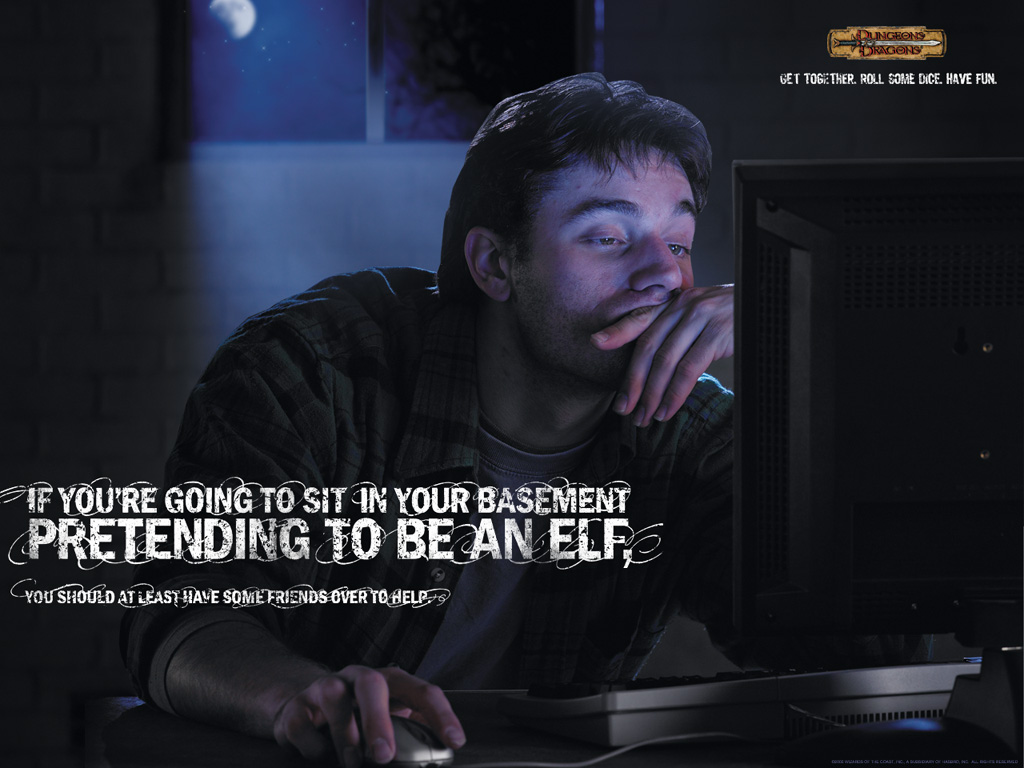
Recently, I’ve been playing more and more tabletop games, ever since I discovered the tabletop game club at Champlain College. I’ve also played a couple of card games there includingMagic: The Gathering and Yu-Gi-Oh. For the uninitiated, both games have the principle of collecting cards from booster packs or pre-made decks, then building customized decks in order to battle other players. Both games are so popular, that there are officially sanctioned tournaments where players can win considerable cash prizes.
With this sort of possibility, players naturally want to make their deck the best they can and be able to play the best they can. There are several factors for players to consider: the types of decks that are most played at tournaments, cards that either become limited or banned, new card sets coming out and the street value of cards. This sort of information gathering and communication between players is known as the Metagame.
Early examples of how players stayed informed.
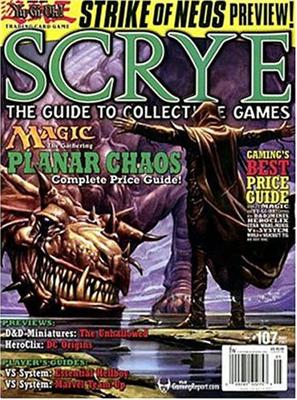
In the early days of CCGs, especially for Magic, keeping up on the latest trends meant magazines such as Inquest and Scrye to find out about the latest cards and strategies as well as your local game and hobby shop. Printed price guides also existed in order to compare the price of certain cards. Even with different set rarities, the values of cards were primarily based on their usefulness in the game, which in turn, raises the demand for them. As for finding out about new cards, aside from maybe a few previews in magazines, there was no way of doing so.
With the advent of the internet, many things changed. While in many cases, it meant that information published in magazines was now available online, this also meant that much more information could be circulated online. However, one of the biggest changes in this is that it is a lot easier for information about upcoming sets to be leaked online. Last year, I was able to find out about the entire Worldwake expansion a month before I saw it in the shops. This means that players have much more time to plan ahead, find the powerful cards from those sets and be able to get their hands on them while the prices are relatively low.
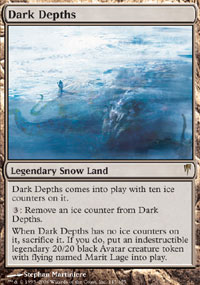
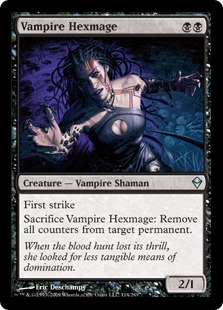
Left: Dark Depths. Right: The Card that causes it to become worth $25.00 more.
Speaking of prices, thanks to the internet, prices for cards can update rapidly. Although in the case of many cards, they change over time, if a new, devastating combo is discovered, it can increase the demand for the card, and thus, the cost. One example is the card Dark Depths. It was considered too slow to work with and too easily dealt with. It was only worth around $4.00. However, once a card released in Zendikar, Vampire Hexmage, allowed all the counters to be removed from it as early as turn 1-3 depending on the format, the price shot up all the way to $30.00 in less than a month. This, combined with the ease of gaining new information about future cards through the internet, makes the metagame even more fast paced, especially if you want to play both competitively and economically.
I opted not to talk about a magazine with groundbreaking political or economic knowledge. Although I do read magazines with such information at times, for the most part, I glance at them when I’m idle somewhere such as the dentist’s waiting room. However, for my magazine, I choose to look at one that was a large part of my childhood: Nintendo Power.
The Issue that started it all
Near the end of every month, I anxiously awaited for my mom to look through the mail and pull out the latest issue of Nintendo Power.As a kid with a Super Nintendo, a Gameboy and later a Nintendo 64 and Gamecube, it was important for me to learn about the latest Nintendo games available. Not only that, but each issue had tips and tricks for games that I owned which proved useful on many occasion.
My favorite section was the classified information section. This contained cheat codes that would otherwise never be discovered by normal gameplay. At the time I read the magazine extensively, the only other way to learn about games was to talk with friends about it, so having the knowledge from the classified information, so knowing the information from that section made you the coolest kid on the block.
However, as technology got more advanced, I got older as well and I eventually cancelled my subscription to Nintendo Power. For one, the internet, especially a site called GameFAQs, had a goldmine of information concerning the latest videogames, not only for Nintendo Systems, but others as well. With the internet being my primary source of information these days, Nintendo Power doesn’t really cut it anymore. However, for its time, it was invaluable.
For more information about Nintendo Power, watch the Angry Video Game Nerd’s look back on it.
I’ve played games online for years, ever since I discovered Counter-Strike¬. For me, it seemed so magical, that I not only could play with anyone in the world, but would always have someone to play with. When your sister doesn’t really play video games and you don’t regularly play with friends, your options tend to be either play single player games or multiplayer with bots, which, though fun, couldn’t quite match up to an actual human player. Having done so, I’ve made several observations, now that the magic has worn off. I’ve played with many different kinds of people, some of them pleasant, others no so much. Many of these are my own personal observations and people I’ve talked to have had a wide range to say about online gaming, from positive to negative.
Attitudes change greatly online. Many times for the worst:
Not everyone is a paragon of friendliness in real life. You’ve seen them before: whether they made snide remarks to a waitress, yelling at someone for a perceived wrong against them or are just prone to picking fights at the drop of a hat. However, for the most part there are consequences for such behaviors in real life: either you won’t have many friends; you won’t get hired at jobs or in extreme cases could get arrested. Not so online. One of the advantages of being online is complete anonymity. Even if you manage to get an entire group of people online to hate you, all it takes is a new screen name and suddenly, your reputation is restored. The removal of any sort of meaningful consequences causes people to be less apt to control their actions. A lot of the reason homophobic, sexist and racist language is heavily associated with online gaming is that people have less qualms about saying such things when there are no consequences for doing so. Try saying some of the things heard in an online gaming session in a work or school environment and see what happens next time.
It feels much less personal playing against a person online than it does in real life:
Back when I got my first gaming system, a Super Nintendo, there was a controller port for a second player. This was the only way that two people could play at the same time. The next console I got, a Nintendo 64, had support for four players. Nowadays, games can support over a thousand players at the same time. Though one thing was different about my older systems. The other players had to be in the same room as me. I fondly remember playing four player games of Goldeneye 007 with three others and not only having an intense game with them but also conversation thrown back and forth. However, I didn’t get to do this that often. With online gaming, all I need is a console and an internet connection and I can jump right into a game. However, something feels lost along the way: a sense of social interaction. Even if I play a tabletop game with a person I’ve never met, it provides an opportunity for me to get to know the person. However, when playing online, it feels more like playing against a faceless nameless machine that occasionally calls you a noob. There have been cases where I’ve been able to get into a game and strike up conversation and even play together with others online and have enjoyed doing so. However, it still doesn't have quite the same atmosphere as a real life game would have.
These days, it seems that video games have less and less in the way of local multiplayer options. Even on consoles, they are focused more on online multiplayer, and if you want to play with more than two people, you'd need several more Xboxes. Heck, even LAN support is starting to fade away, with Starcraft II not offering it. Perhaps this is why I've been playing seeking to play tabletop games more and more these days: as much as I love online gaming, it still doesn't quite connect people the way traditional gaming does.
My name is Corey Moore, from Stratham, NH, although my family is eventually moving to Glen, NH. Although I mentioned in class that my Xbox360 was a fun media experience, another one I had was having skype voice chats with several people. I like the way that 21st century media allows people to communicate on a greater scale, though I despise the advertisements intruding in on me. Although I plan to go into the game industry, I am not sure about my future there.